The teeter-totter rule
The Dark HalfThe teeter-totter rule is the bodily law governing Thad Beaumont and George Stark’s shared writing: as one gains strength, the other declines. It makes their writing session more than a contest of authorship. Thad understands it as an exchange of power, with Stark’s recovery balanced against changes in Thad’s body, and the rule gives physical form to the danger of their connection.
The exchange behind the writing
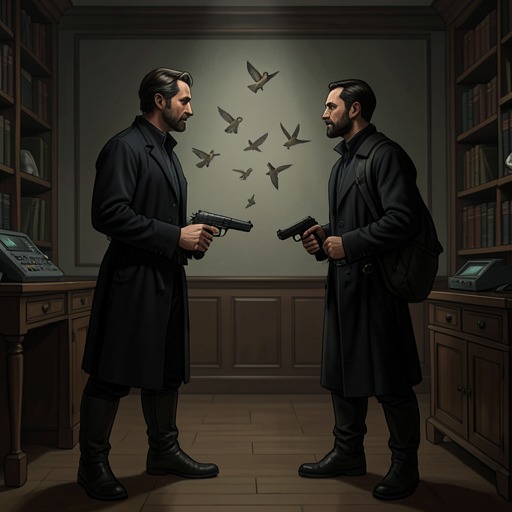
Thad recognizes that the two men understand what is taking place even though neither can fully express it. Writing, he concludes, is not the real purpose of their work together; it is a ritual through which they pass a kind of baton. The exchange is a trade: Liz’s and the twins’ lives on one side, and something Stark demands on the other. Thad knows what that price is. Stark wants his “third eye,” the inward-looking faculty buried in Thad’s brain.
This recognition establishes the rule’s stakes. The apparent collaboration does not make the men equal participants: Stark has the greater force, while Thad has only the “scraggy birds” that may oppose him. Thad resists the sensation that Stark is probing for what he knows, insisting to himself that Stark should not be allowed to peek. The unspoken terms of the exchange therefore matter as much as the writing itself: the ritual lets power move between them, but it does not make the bargain safe or voluntary.
The seesaw principle
Stark gives the exchange its governing image when he compares it to a teeter-totter: when one end rises, the other must fall. Thad accepts that they will recognize the moment when the trade has taken effect, and Stark agrees. The rule is presented not as an abstract theory but as a shared expectation about what their bodies will reveal.
The image also clarifies the asymmetry of their condition. The men are connected closely enough for one body’s improvement to coincide with change in the other, yet neither can simply choose to benefit without consequence. Thad’s thought that one end going up requires the other to come down turns their physical changes into the measure of their ongoing contest. The rule’s force lies in this balance: recovery is not an isolated gain, but part of a transfer.
Physical evidence of the transfer
The writing provides an observable test. After Thad reads what Stark has written, he notices a sore at the corner of his own mouth and sees that a similar sore has disappeared from Stark’s. He recognizes this as evidence that the exchange is happening. The small, paired change translates their private understanding into something visible on both bodies.
The shift becomes more pronounced as Stark loses himself in the violent fictional world of Alexis Machine. His condition improves: sores disappear, damaged skin grows pink and begins to knit together, missing eyebrows return, and the discharge that had stained his shirt dries. The change is not merely a momentary impression; several signs of his earlier deterioration recede together while he is absorbed in writing.
Thad, meanwhile, touches a sore beginning to form on his left temple and finds moisture on his fingers. When he checks again, the skin is smooth, but the small white scar left by the operation performed in the year his “real life” began has disappeared. The bodily exchange thus reaches beyond a newly appearing sore: it affects a mark that connects Thad’s present condition to his earlier medical history. The teeter-totter principle makes the relation between writing and physical change concrete without making the bargain’s full outcome immediately clear.
A law with an approaching consequence
Thad summarizes the pattern to himself as a law of nature: when one end of the seesaw rises, the other must fall. In the scene, Stark is visibly improving while Thad finds a new sign of change on his own body. The comparison makes their connection feel governed by a rule neither can evade merely by naming it.
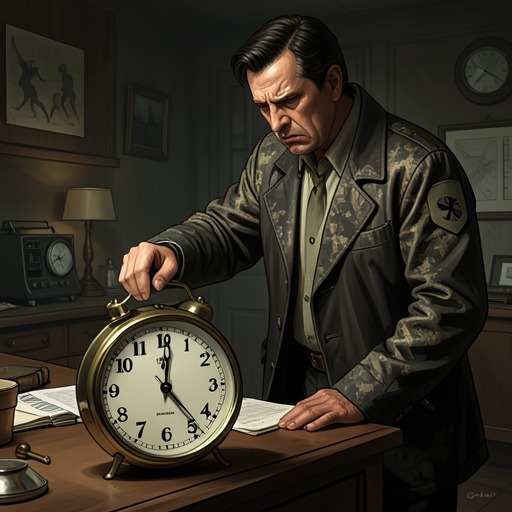
The rule also shapes the urgency of what follows. Thad notices that his watch has stopped at quarter of five, so it offers no help in deciding how late it is; he thinks he will have to act soon. Stark, having put out a cigarette, asks whether they should continue or take a break. The contrast between that ordinary pause in their work and Thad’s awareness of the approaching decision leaves the exchange unresolved: the men have seen the bodily evidence, but the cost of completing the transfer is still ahead.
Significance
The teeter-totter rule binds authorship, physical condition, and coercive stakes into one mechanism. The writing is a ritual for exchanging power, and the corresponding changes in the men’s bodies make that exchange legible. Stark’s renewal is accompanied by signs of decline or alteration in Thad, while Thad understands that what Stark seeks is not simply a story but his inward-looking faculty.
The seesaw image therefore supplies a compact structure for their conflict: each apparent gain is shadowed by a loss on the other end. It also prevents the scene from treating their shared writing as a neutral creative partnership. Even when Thad tells Stark to continue, the bodily evidence and the price he has identified remain present. The rule explains why the act of writing can serve simultaneously as collaboration, transfer, and threat.